
No Hungry Learners: How Young People from Wrexham Took Their Campaign to the Senedd


A campaign led by young people at St Joseph’s, supported by Together Creating Communities (TCC), helped bring the issue of school hunger and school meal debt into the heart of Welsh parliamentary discussion. As the Welsh Government takes further steps to widen access to free school meals, we look back at the importance of their work.
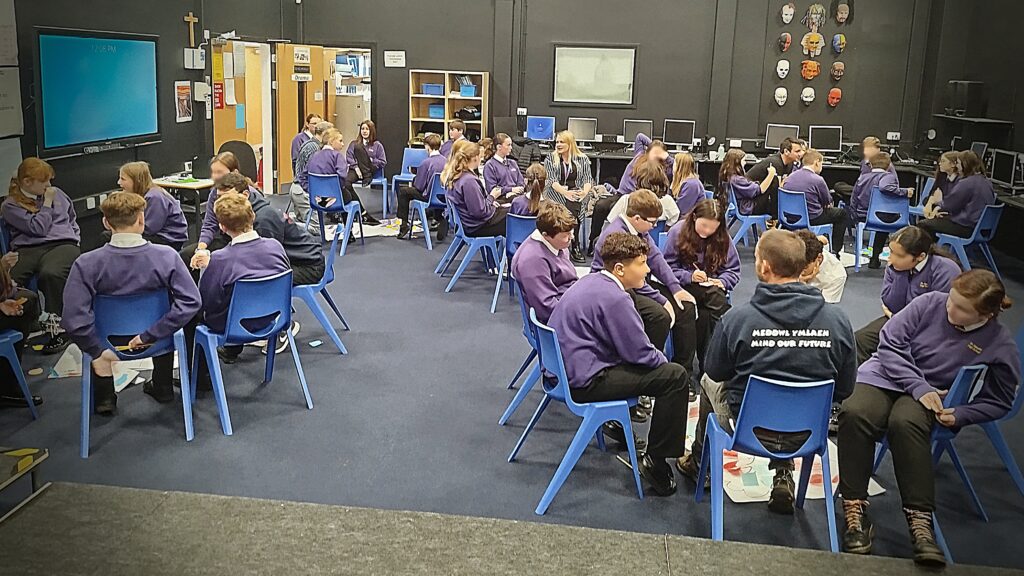
A few years ago, young people from St Joseph’s Catholic and Anglican High School in Wrexham decided that something needed to change.
They were concerned that pupils at their school were going hungry because their families could not afford to pay for school meals. They were also concerned about the stigma and embarrassment experienced by young people who were refused meals because of debt on their accounts.
With support from Together Creating Communities (TCC), they developed a campaign called No Hungry Learners.
Rather than relying on assumptions, the young people set out to understand what was happening in their own school. They conducted research among their fellow pupils, and the findings were stark.
Their survey revealed that:
- 30% of pupils surveyed said they had been refused a meal because of debt on their account.
- 30% said they had skipped a school meal because they did not have enough money.
- Of those who had been refused a meal, 73% said they had been told about the debt in front of their peers.
These figures highlighted an issue that went beyond the provision of school meals. It was about the impact of poverty on young people’s daily lives, their dignity and their ability to participate fully in school.
The young people believed that no learner should go hungry because their family was struggling financially, and that no pupil should be publicly embarrassed because of school meal debt.
From the school gates to the Senedd
The No Hungry Learners campaign did not remain within the school.
Supported by TCC, the young people developed their arguments, shared their findings and took their concerns directly to decision-makers. They met with their headteacher and local elected representatives, including Members of the Senedd Ken Skates and Lesley Griffiths.
Their campaign video was selected to open the Wales Child Poverty Summit in 2023, giving their message a national audience.
The campaign also reached the Senedd Petitions Committee. The young people’s evidence and concerns were discussed by the Committee, which recognised the importance of the issue and undertook to write to the Cabinet Secretary for Education to share the evidence.
This was an important moment. The experiences of pupils in one Wrexham school had become part of a formal parliamentary discussion about school meals and the responsibilities of government.
It demonstrated what can happen when young people are given the opportunity and support to do more than express an opinion. They can gather evidence, develop a campaign, challenge decision-makers and contribute to the scrutiny of public policy.
Continuing progress in Wales
On 22 June 2026, the Welsh Government announced an additional £15 million to begin expanding free school meal eligibility to more secondary school pupils in households receiving Universal Credit.
The announcement included removing the existing £7,400 annual net household income limit for these families. The funding comprised £10 million for school kitchens and dining facilities and £5 million towards introducing and expanding the provision. The initial plan was for parents and carers of pupils in Years 7 and 8 to be able to apply from September 2026.
This represents a further step towards widening access to free school meals and reducing the financial barriers faced by families.
It is important to recognise that the Welsh Government’s 2026 announcement is part of a wider programme of work, and that no single campaign can be credited with delivering a national policy decision. However, the No Hungry Learners campaign had already brought the experiences of young people directly into the Senedd’s consideration of school meals policy.
The connection is therefore more than a similarity of ideas. The young people had taken their evidence and concerns into the parliamentary process, helping ensure that the realities of school hunger and meal debt were heard by those responsible for education policy.
The work is not finished. Wider eligibility does not, by itself, resolve every issue raised by the campaign, particularly the stigma and treatment associated with school meal debt. But it is encouraging to see further action being taken to remove financial barriers to accessing food at school.
Why this is what TCC does
No Hungry Learners remains an important example of TCC’s approach to community organising.
Our role was to support young people to identify an issue that mattered to them, investigate it, develop their own campaign and engage with the people and institutions able to influence change.
The young people were not simply consulted or invited to give their opinions. They took ownership of an issue, built an evidence-based case and carried their message into the public and political arena.
That distinction matters.
Young people are often directly affected by decisions made by adults, but are not always given meaningful opportunities to influence those decisions. No Hungry Learners showed the value of changing that relationship.
It also reminds us that community organising is not just about raising awareness. It is about helping people build the confidence, relationships and collective voice to challenge the things that need to change.
We are proud of the young people from St Joseph’s who made this campaign possible, and grateful to everyone who supported them along the way.
Their work helped bring the issue of school hunger into the Senedd. Their message remains as important today as it was when they first began campaigning.
No learner should go hungry. And every young person should have the opportunity to make their voice heard.



Responses